crypto
How Boson Protocol designed tokenized commerce
Explains Boson Protocol's 2021 design for tokenizing physical commerce with commitment tokens and NFTs, a historical snapshot of a since-redesigned protocol.
2026 status note: this essay describes Boson Protocol's 2021 (v1) design and plans as pitched at the time. The protocol was later redesigned, so the tokens, mechanisms, and Decentraland plans below are a historical snapshot, not the current system.
Named after a class of elementary particles that includes force carriers, Boson Protocol presented its mission as building a decentralized commerce system for physical goods.
The proposed toolset used Ethereum as a settlement layer for commitments around physical goods and services. The contracts could reduce dependence on a central marketplace, but the physical exchange could not be trustless.
The design tokenized claims on physical items through NFTs, the creation of liquid digital markets for these NFTs, and, as a byproduct, a new market for the commerce data those transactions produce.
The early Internet promised a future of fair and accessible data for all.
Instead, market forces favored centralized infrastructure for its profitability.
This trend extended to e-commerce, where intermediaries now dominate.
These intermediaries often control customer data, marketplace access, and transaction fees.
Crypto infrastructure, including public blockchains, NFTs, and digital wallets, has given vendors a level of control that wasn't available a decade ago.
Boson's proposal was to move some of those functions into public contracts, though shipping, customer support, identity, and legal enforcement would still depend on off-chain parties.
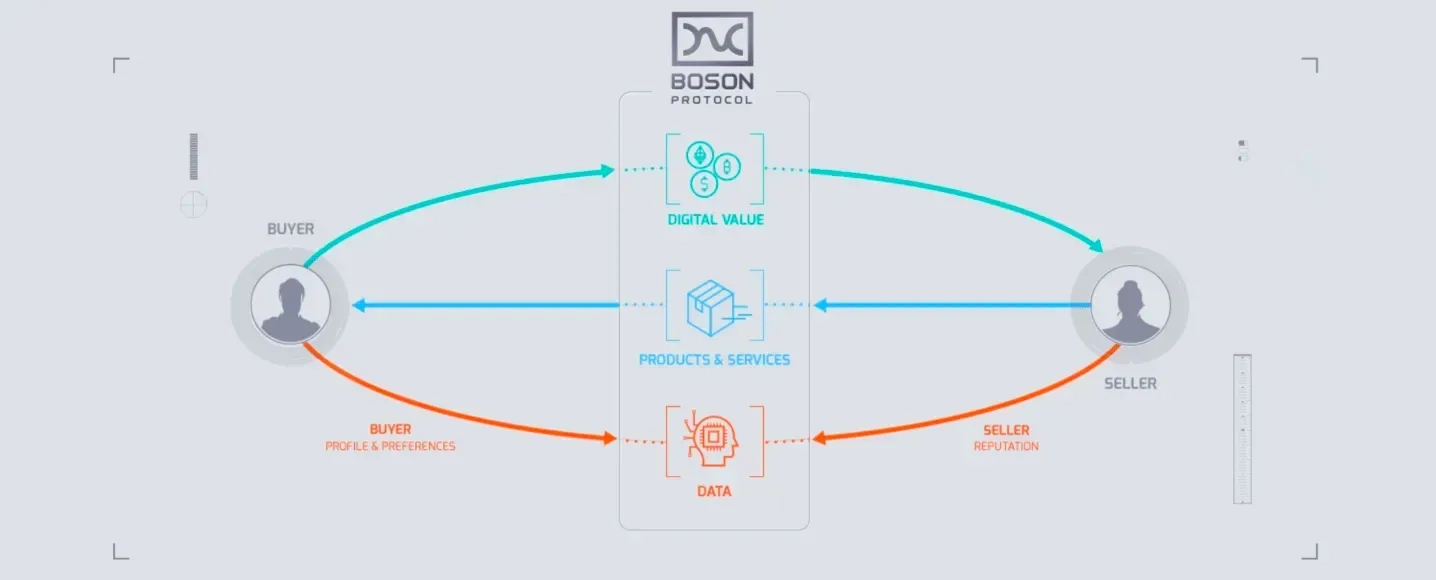
Inspired by tokenized decentralized finance (DeFi) systems, Boson Protocol aimed to reduce marketplace fees and gatekeeping through a decentralized commerce protocol.
The functionality surrounds what are called Commitment tokens, Thing tokens, and the role of the BOSON token.
Commitment tokens
A Buyer and Seller commit to exchange digital value for a physical item (a Thing).
This commitment is funded and represented by an NFT linked to an escrow contract.
The NFT serves as a voucher to buy or sell an item, so Boson refers to them as NFTVs.
The NFT contract has an expiration date and obliges the seller to deliver the listed item. This resembles one feature of a futures contract, but the design is escrow with an expiry date. It lacks the standardized terms, margining, and clearing of a futures contract.
Commitment Token holders are granted the right to transfer their token to another wallet or reliably and securely redeem the token for a particular Thing.
Commitment token characteristics
Boson describes Commitment tokens as universal, interoperable, composable, programmable, transferable, storable, and stateful.
The Core Exchange Mechanism governs Commitment Tokens, where the programmed game theory comes into play. Buyers and Sellers sequentially deposit up-front funds, so there are varying levels of skin in the game on both sides of the transaction.
The final deposit transfer process is structured to incentivize both parties to behave well.
Using this sequential transaction process, Commitment Tokens can achieve a 'Subgame Perfect Equilibrium,' a concept from game theory.
The mechanism was designed to make honest completion more attractive than defection at each stage. That design does not guarantee a fair outcome or remove disputes involving the physical item.
More precisely, a subgame-perfect equilibrium is a strategy profile that forms a Nash equilibrium after every possible stage of a sequential game. Boson's claim depended on its payoff assumptions and dispute process matching real buyer and seller behavior.
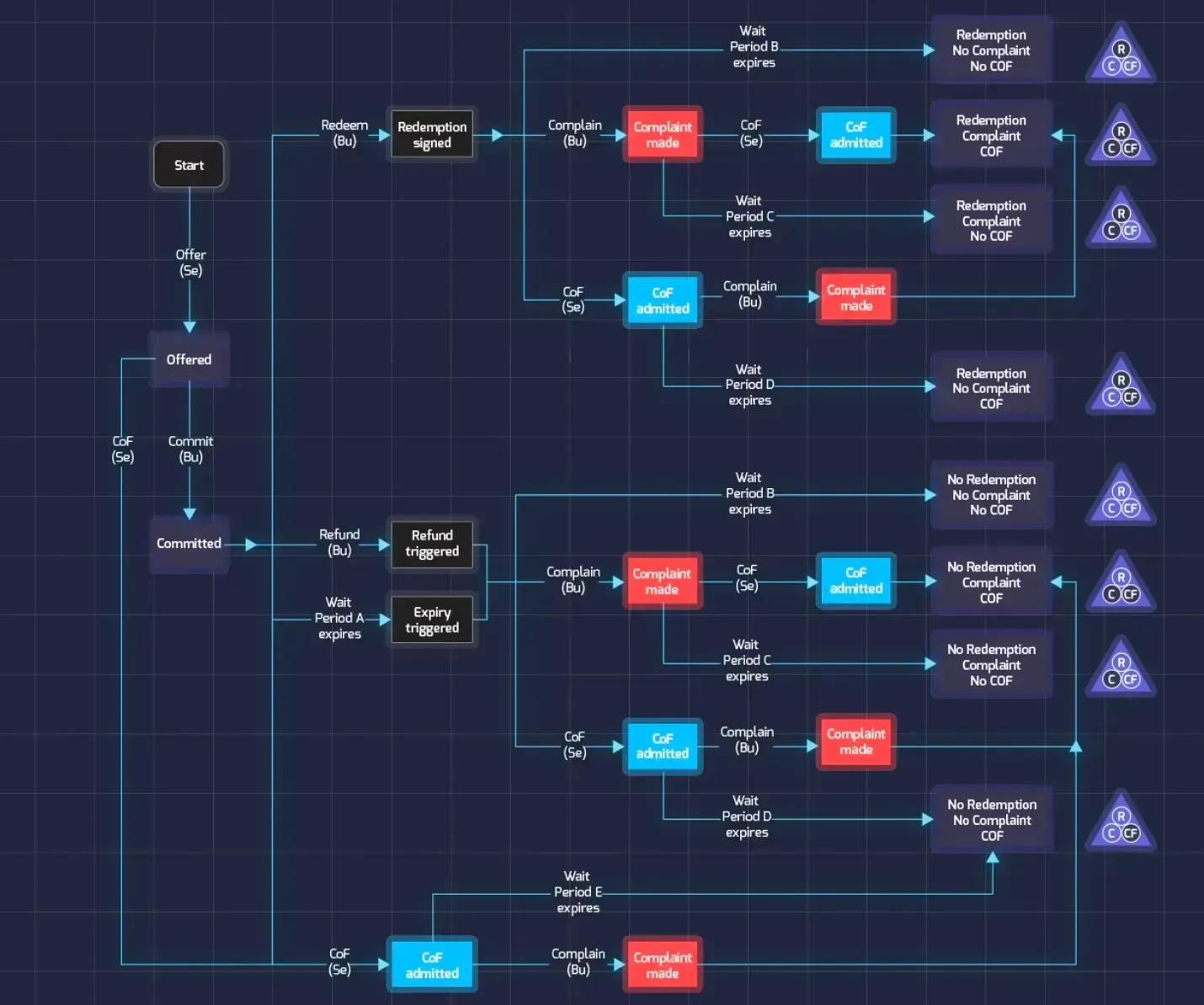
The possible game outcomes are the triangles on the right side of the above diagram.
CoF stands for Cancel or Fault, which is an undesirable outcome.
The most desirable outcome for all parties is 'Redemption; No Complaint; No CoF,' which is the fourth triangle from the top of the diagram.
The purpose was to make cooperation cheaper than a dispute under the modeled payoffs. Whether it reduced real disputes required evidence from completed transactions.
Thing tokens
Thing Tokens, which conform to the ERC-20 standard for fungible tokens, are used to purchase Commitment Tokens. The white paper compared a Thing token with a generalized Unisock. Calling the voucher a futures contract is only an analogy because it lacked standardized exchange terms and clearing.
Unisocks are a grand experiment in scarcity.
There were 500 real pairs of Uniswap merchandise socks tokenized as SOCKs and deposited into a liquidity pool on Uniswap along with their starting value worth of ETH.
Unisocks
Each SOCK token represented a redeemable pair of socks and traded through a bonding curve. By this essay's August 2021 snapshot, its quoted price had risen 11,048.07% from the original $12.
At the time, a holder could sell the token into its liquidity pool or redeem it for a physical pair, subject to the redemption operator's terms and shipping coverage.
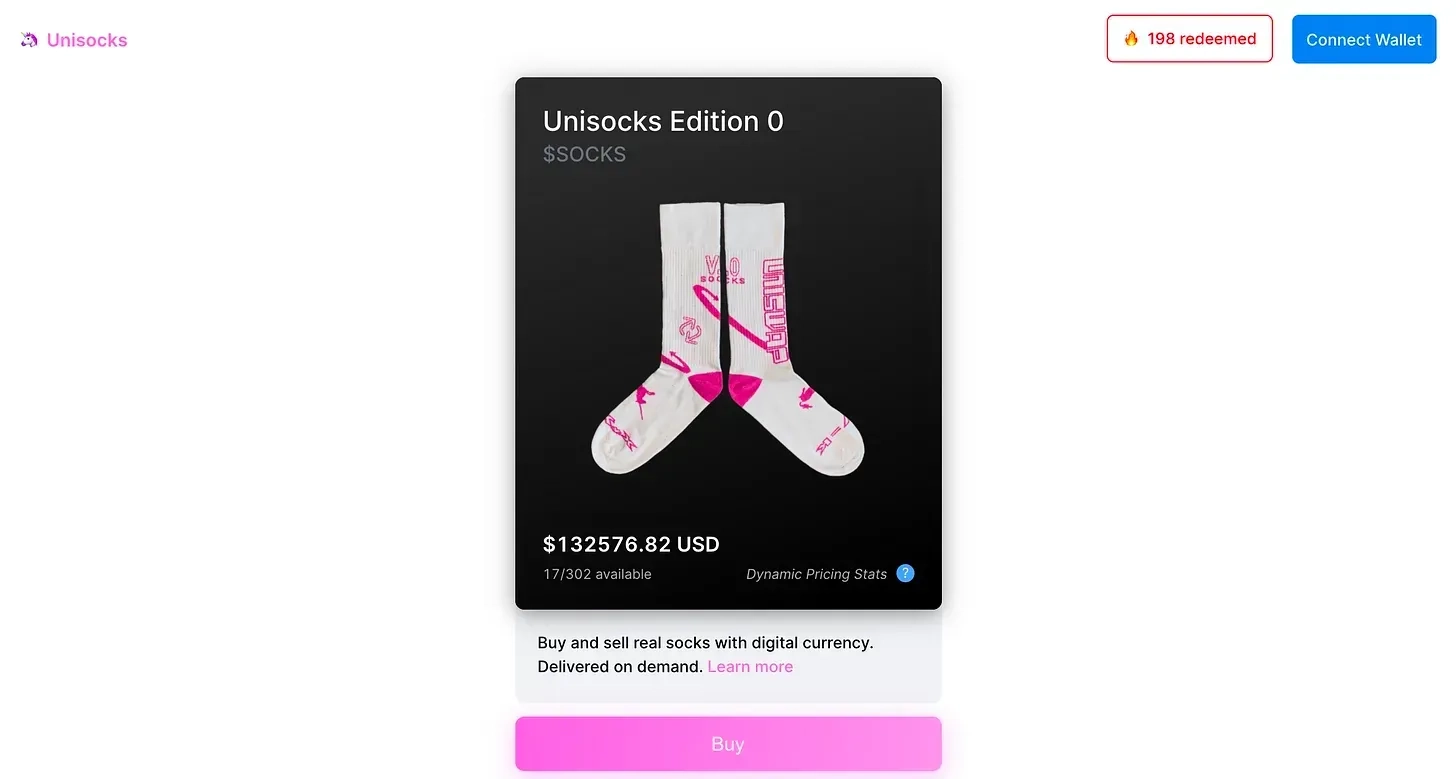
At the August 2021 snapshot, the quoted price of a single $SOCK token had exceeded $100,000, and 192 pairs had been redeemed.
Thing tokens are similar. Boson intended Thing tokens to work with compatible DeFi contracts. Integration was not automatic across every protocol.
They are tradable in the same way you can trade SOCKs between different wallets, and they can 'plug' into AMMs (Automated Market Makers) to create liquid digital markets.
Their use cases within DeFi include product price discovery on DEXes, yield optimization, and the crowdfunding of non-existent products through ITOs (Initial Thing Offerings).
Boson tokens
Incentives are the invisible hand that Adam Smith was talking about. Boson built reward mechanisms within the Thing-Commitment Token relationship to incentivize good behavior by both Buyers and Sellers, but that doesn't tell the whole story.
Boson described the protocol's objective as "maximizing the supply of quality redemptions." In other words, it sought to facilitate successful commerce transactions.
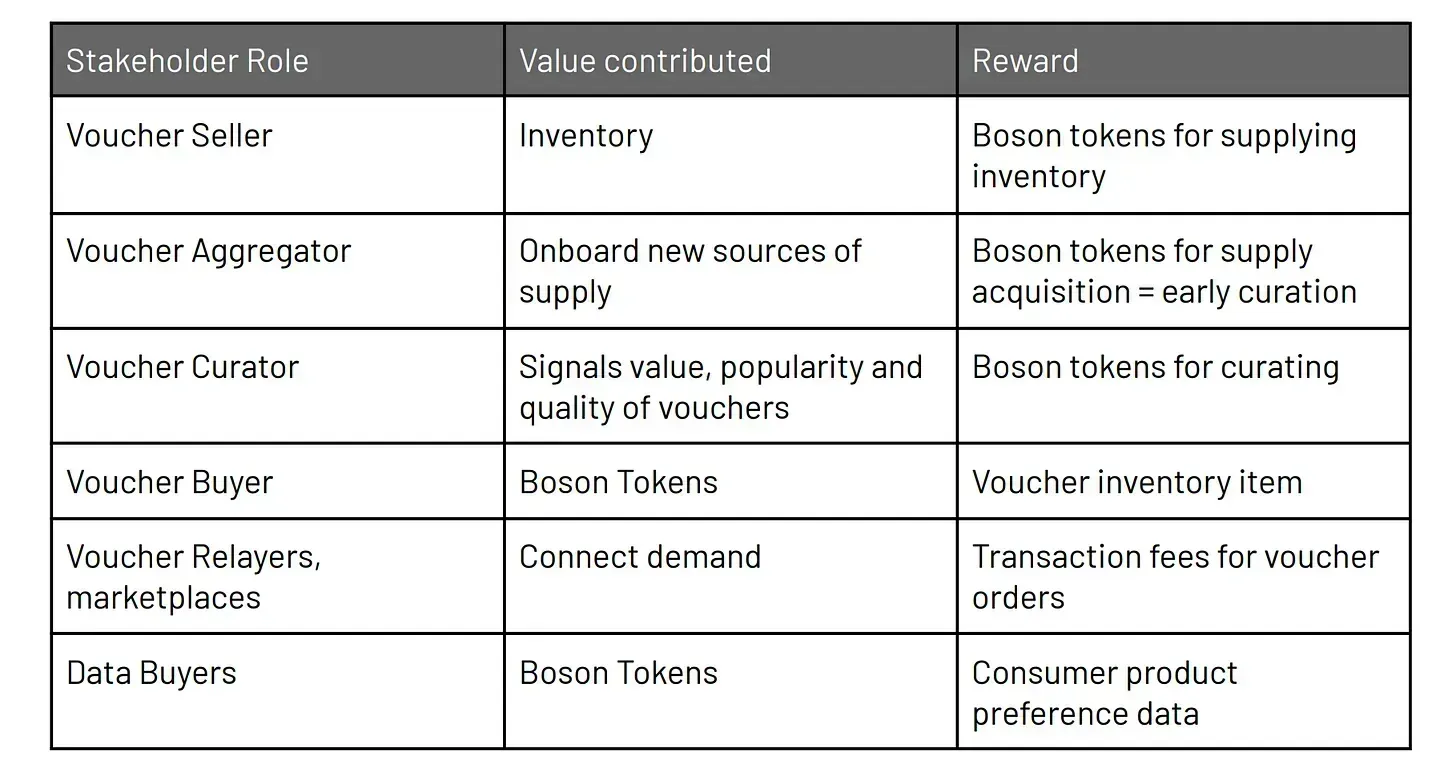
To do so, Boson implemented the BOSON token (Bosons) as a monetary reward for actors within the Boson ecosystem who help the protocol reach its objective.
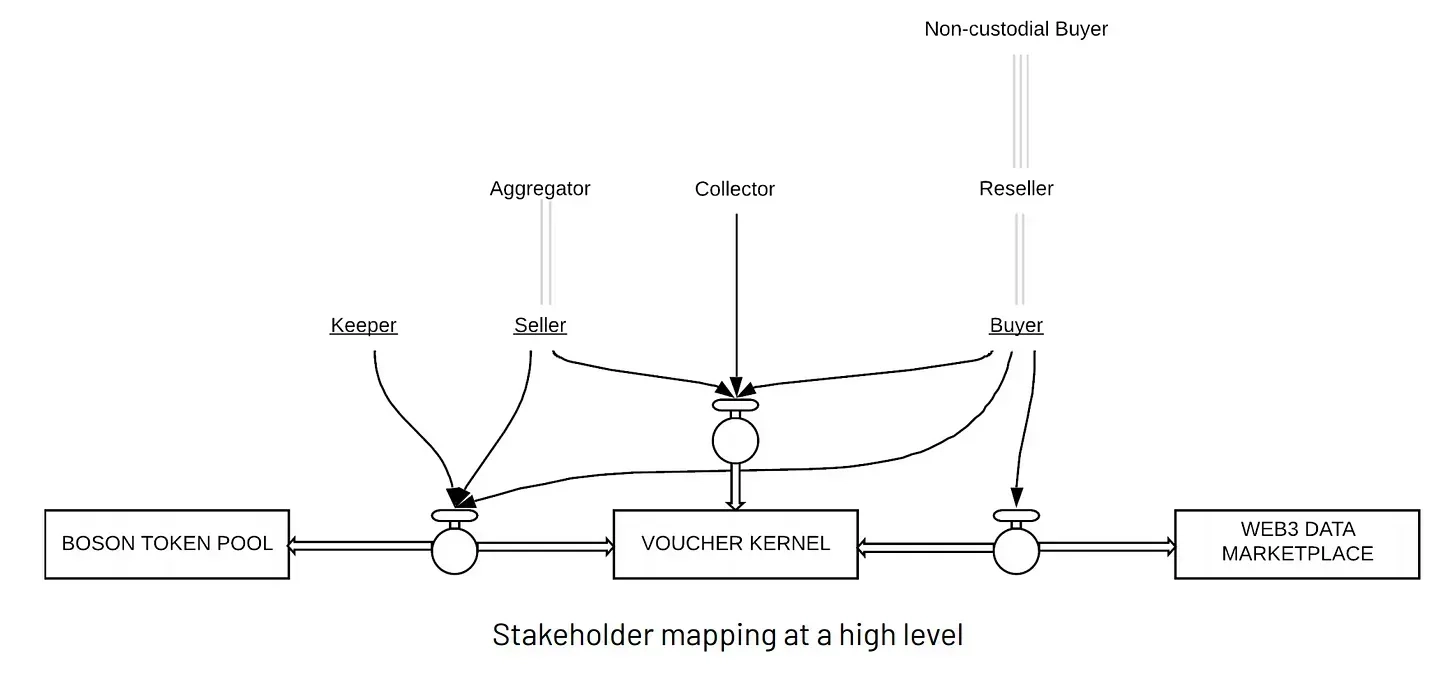
A high-level overview of the main stakeholders within the Protocol:
Gluons
There are also gluons, which act as quality indicators, encouraging participants to stake more capital for higher-quality items. The system used stake as a signal of participant commitment. A larger stake did not independently verify the physical item's quality.
Each voucher has a unique derivative called a Gluon that represents the stake of the participant holding the voucher and the associated BOSON reward.
Vouchers with more Gluons represented more stake under the proposed model.
Planned commerce applications
| Vertical | Description |
|---|---|
| Online Commerce | Decentralized e-commerce platform |
| M2M commerce | Autonomous machine-to-machine transactions |
| Loyalty and rewards | Interoperable, composable reward systems |
| Gaming | Physical rewards for in-game achievements |
| Service Bookings | Permissionless, two-sided deposit bookings |
The 2021 scaling plan
In 2021, Boson estimated that it would need to handle an average of 10 transactions per second, with peaks potentially exceeding 10 times that. It chose Ethereum, which in 2021 had the largest established smart-contract developer ecosystem but limited layer-1 throughput and variable fees. By August 2021, Boson reported raising $36 million and hiring teams covering protocol design, architecture, legal, engineering, and game theory.
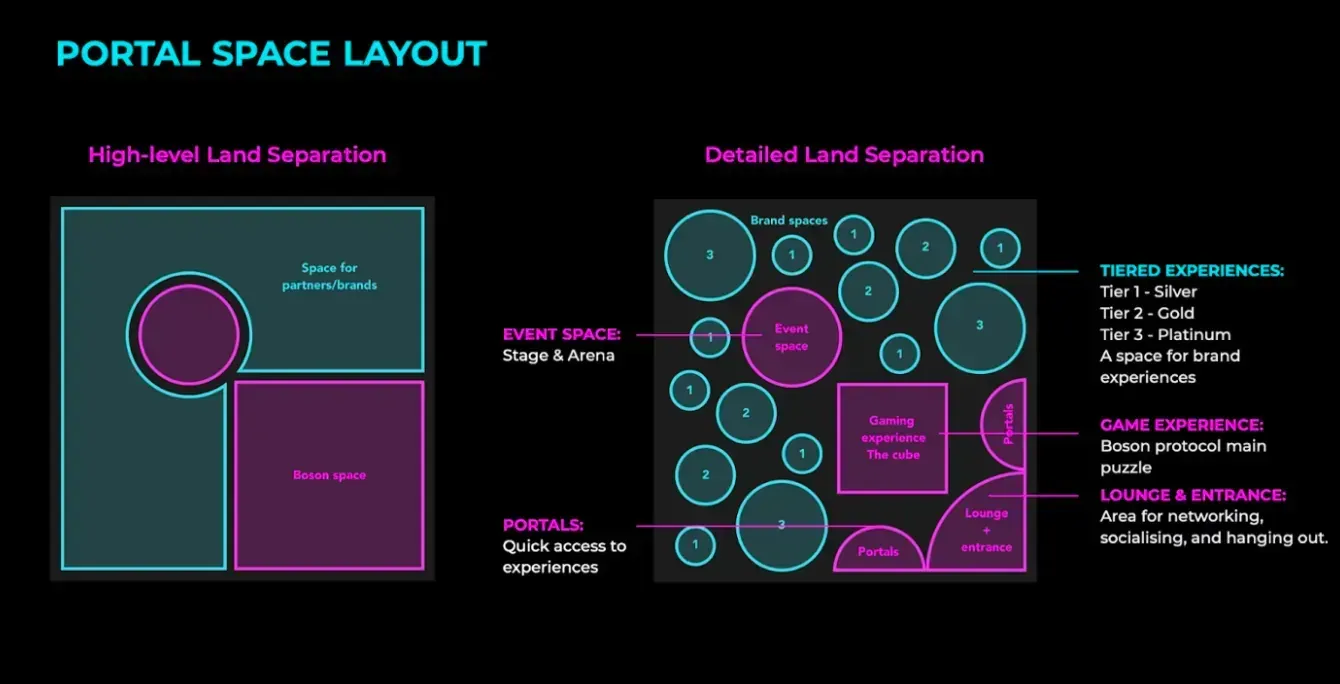
After expanding its team beyond 50 people, Boson reported purchasing more than $700,000 in digital real estate within Decentraland's Vegas City to create Portal, a lifestyle and commerce playground.
The plan was for Portal to enable creators and brands to sell redeemable NFTs for real-world products and services.
At publication, Boson described itself as being in "hyper blitz scale mode." That phrase reflected the team's roadmap, not evidence of adoption. Evidence of adoption would include established brands listing real inventory, sustained redemption volume on those vouchers, and sellers returning without token incentives.