tech
Web 2.0: User-generated content and advertising data
Explains how user-generated content, network effects, and advertising data helped a few platforms gain strong positions in search, social media, and commerce.
Since the onset of Web 2, much internet use has centered on interactive applications, social media, marketplaces, and user-generated content.
The resulting network effects helped a small number of intermediaries gain strong positions in search, social media, advertising, and commerce.
Those positions give the largest platforms substantial influence over what billions of people see and buy.
Generational context
Strauss-Howe analysis
For a deeper understanding of the cultural shifts underlying the advancements and applications of the Internet, this series will distill a cross-generational perspective through the lens of the Strauss-Howe Generational Theory.
To reiterate: the theory is a contested interpretive framework, and this series does not argue for its validity. It's used only as an anthropological angle from which to view technological advancements.
The theory details a recurring cycle of generations that introduce archetypes who possess behavioral traits associated with the period in which they grew up.
The world theoretically entered a crisis phase with the onset of 9/11, although some argue it didn't take full effect until around 2008 when the Great Recession began.
This period brought about an international war on terror, enormous military spending, global financial hardship, the rise of large technology platforms, and political polarization. Social media changed information distribution during this period, but it is not a complete explanation for polarization.
Archetypes
Each generation grows up in a different phase, either a High, an Awakening, an Unraveling, or a Crisis, and the context of these phases informs the types of individuals who emerge from them.
The theory groups the cycle into four recurring archetypes:
| Archetype | Born during | Comes of age during | Claimed tendency |
|---|---|---|---|
| Prophet | High | Awakening | Values-driven |
| Nomad | Awakening | Unraveling | Pragmatic |
| Hero | Unraveling | Crisis | Institution-building |
| Artist | Crisis | High | Process-oriented |
The authors claim that the period in which a cohort grows up shapes these tendencies. The table summarizes their model, not measured personality traits.
Artists and heroes
The theory calls people born during a Crisis "Artists" and assigns them traits such as sensitivity, adaptability, and process orientation. These broad labels are interpretive claims rather than measured descriptions of a cohort.
The theory associates the Hero archetype with confidence and institution-building, and the Artist archetype with process and consensus. A Silicon Valley slogan or one executive cannot validate those cohort-wide claims.
Examples of Artists in history include some of America's founding fathers and former US president, Theodore Roosevelt.
Strauss and Howe describe this archetype as emphasizing social process, fairness, and inclusion. That description belongs to their model, not a verified account of the named individuals.
The rise of crypto
Younger cohorts in this period grew up during rapid internet and smartphone adoption.
Smartphones and social networks exposed younger users to events and communities far beyond their local environment. The effects vary and cannot be assigned to one shared generational psyche.
The web uses decentralized protocols, but Web 2 services often concentrate data and control within companies. Crypto projects renewed interest in distributed ownership and settlement. Generational theory does not establish who supports that shift or why.
The transition to Web 3 claims is easier to assess after examining Web 2's history, business models, and control points.
Web 2 evolution
History
Web 1 supplied protocols, browsers, hosting, and network infrastructure that later interactive applications could use. Investment in internet companies accelerated in the late 1990s before the dot-com bubble burst.
The tech bubble
Capital raised during a bubble can fund infrastructure and experiments, but bubbles are not necessary for adoption and can destroy savings and viable firms.
The dot-com crash did not eliminate e-commerce. Likewise, the 2017 crypto crash did not eliminate every blockchain application, but survival alone does not validate a product or valuation.
While many of these ideas (like decentralized ride-sharing services) did not pan out, others, like NFTs and synthetic assets, found real adoption waves.
Whether those waves compound into lasting industries is still being tested.
Some technologies improve or spread along nonlinear curves, while adoption can also plateau or reverse. Forecast errors run in both directions.
To understand this from a high level, consider how semiconductors conform to Moore's Law and technological networks conform to Metcalfe's Law.
Moore's Law
According to Moore's Law, the number of transistors in a dense integrated circuit (microchip) doubles every two years.
The observation has held remarkably well since Intel's microchips debuted in the early 1970s, though it is an industry heuristic rather than a physical law.
These transistors improve computing power and enable technological advances that drive unforeseen societal changes across all industries.
Metcalfe's Law
Metcalfe's Law models the value of a telecommunications network as proportional to the square of the number of users in the network.
It's a heuristic for the power of network effects; real networks show diminishing returns as marginal connections matter less, but it captures why they snowball.
As each new user is introduced to a network, they bring the capacity to introduce other new users and interact with the previous users.
This creates an economy of interactions that expands rapidly as more people join the network while, in the idealized version of the argument, costs grow only roughly linearly.
Key innovations
Social media
Many Web 1 sites offered limited in-browser publishing and interaction, though email, forums, chat, and early social services were already active.
In 1999, Web 1 was compared to the embryo of the Web to come, and Web 2 began circulating.
The term has been defined in various ways, although the common understanding of it being related to user-generated content was widely understood when social media networks took over.
Social media became one of Web 2's largest distribution systems for news, entertainment, advertising, and interpersonal communication.
Near the end of Web 1, Myspace and Facebook followed earlier social networks and became large mainstream platforms. They made persistent online identity and connection easier for hundreds of millions of users.
Posting and interacting with distant audiences opened new routes for creators to publish and earn income.
More people gained quick access to information and distant communities, though access, language, moderation, and reliability remained uneven.
This facilitated an explosion of content creation, curation, interaction, and even whistleblowing, as there were now countless avenues through which people could distill and obtain their information.
Information distillation
Old photographs of public transportation often show many riders reading a small number of newspapers. That distribution model concentrated editorial selection, though readers did not necessarily hold the same views.
It's similar to how most people are now on their phones and have headphones on when riding public transportation, except now everyone is reading and listening to their algorithmically curated news feeds.
These news feeds disrupted big media because anyone could make a media channel and distill information to their following, irrespective of their background or credentials.
This affects how news is distributed and ingested in many other areas of society.
Rather than every comedian trying to land a spot on Saturday Night Live or a role in a big NBC network show that aired at 7 p.m. on Monday nights, for example, they can start a YouTube channel or a podcast, air their special on Netflix, or even star in their show offered by a streaming service and go viral.
This distributed publishing power, even while audience discovery remained concentrated in platform algorithms.
E-commerce
A few decades ago, Web 2's e-commerce tools changed traditional retail and distribution.
Platforms like eBay, Etsy, Shopify, Amazon, Reverb, and thousands of other e-commerce websites enabled many more people and businesses to build virtual stores and sell physical goods.
Before large online marketplaces, manufacturers, wholesalers, retailers, and catalog businesses controlled much of product distribution.
Large firms retained advantages in capital, logistics, and placement. Smaller sellers gained access to customers, but remained dependent on platform fees, ranking systems, and policies. E-commerce has quickly become a standard operating procedure for celebrities with a devoted following.
E-commerce doesn't only apply to real-world goods. It applies to any transaction made virtually. Disparate industries like gaming and sex work have been flipped upside down as platforms like Twitch and OnlyFans have generated hundreds of millions of dollars in paid subscriptions for their content creators.
These platforms are entirely built on user-generated content and have their own novel sets of pros and cons dealt with in Web 3.
Moderation, privacy, and platform control
Web 2 business models
Web 2 produced large platforms such as Facebook, Amazon, and Google that provide communication, commerce, search, and infrastructure services.
Many of their services are funded by advertising, marketplace fees, subscriptions, cloud services, or retail margins. User attention and behavioral data are inputs to some of those models.
The more you peruse Facebook, the more Facebook knows about you and how to market to you. The details differ by platform. Marketplace operators can compete with third-party sellers while also controlling fees, rankings, and access to customer data. That combination creates conflicts even when no specific ranking decision can be observed from the outside.
These conflicts have prompted regulation, competition policy, privacy tools, and experiments with alternative architectures.
Privacy concerns
As Web 2 platforms matured, their side effects became more evident.
To the unsuspecting eye, these free platforms and all the free things you could do on them seemed like the product being offered.
The more precise concern is that some platforms monetize attention by collecting data and selling targeted advertising. Users receive a service in return, but often lack clear knowledge or control over the data flow.
Hacks and data leaks
Hacks and data leaks are common problems.
In November 2021, about 7 million Robinhood accounts had their data exposed to an anonymous third party.
Robinhood notified affected users and faced legal and regulatory consequences. Contract terms do not automatically remove a company's liability, and users are not responsible for a service provider's security failure.
Data collection and advertising
Tracking pixels, software-development kits, cookies, device identifiers, and data brokers can connect activity across sites and apps. Similar ads can also result from contextual targeting or coincidence, so a single ad does not reveal which data path produced it.
To be precise about the business model: platforms mostly sell targeted access to you rather than the raw data itself; the raw stuff is the data brokers' trade. Either way, everyone in the chain makes money from predicting and influencing attention and purchases.
More use can produce more ad inventory and behavioral data, although the revenue model differs by service.
Moderation and control
Some blockchains make ledger entries harder for one company to remove, but apps, hosting, domains, stablecoin issuers, and interfaces remain possible control points. Web 2 platforms can remove content or accounts under their rules and legal obligations.
Large intermediaries can suspend access under their terms and legal obligations. Market power, notice, appeals, and viable alternatives determine how much practical recourse a user has.
This matters for political speech and whistleblowing, but moderation also addresses harassment, fraud, exploitation, and illegal content. The hard issue is governance, due process, and transparency, not the absence of rules.
False and misleading information
Web 2 enabled individuals to create content networks, drastically changing how society ingests said content. The ramifications of this shift are both positive and negative. It became easier to publish fabricated news or toxic claims with limited accountability.
Nefarious actors can infiltrate an emerging market and manipulate societal belief systems and political elections while spreading distrust in centralized governance systems.
Distributed publishing is one factor. Platform incentives, political actors, legacy media, and private messaging also shape how false claims spread.
When everyone used to read the New York Times every day, they ingested the same content.
Now, hundreds of networks exploit the 24/7 news cycle to compete for users' attention spans by creating clickbait, which is false, misleading, or unverified news meant to initiate engagement.
Negative and sensational headlines can attract engagement within social feeds. How that affects polarization depends on the platform, audience, topic, and recommendation system.
Attention-driven headlines predate the web. Social platforms made their reach and performance measurable in real time.
Web 2 expanded participation and concentrated control
Web 2 made communication, publishing, and commerce more accessible across distance while concentrating distribution in a small number of platforms.
It created large companies and new forms of work, commerce, publishing, and community. The gains and harms were uneven, and broad claims about poverty or wealth creation require separate economic evidence.
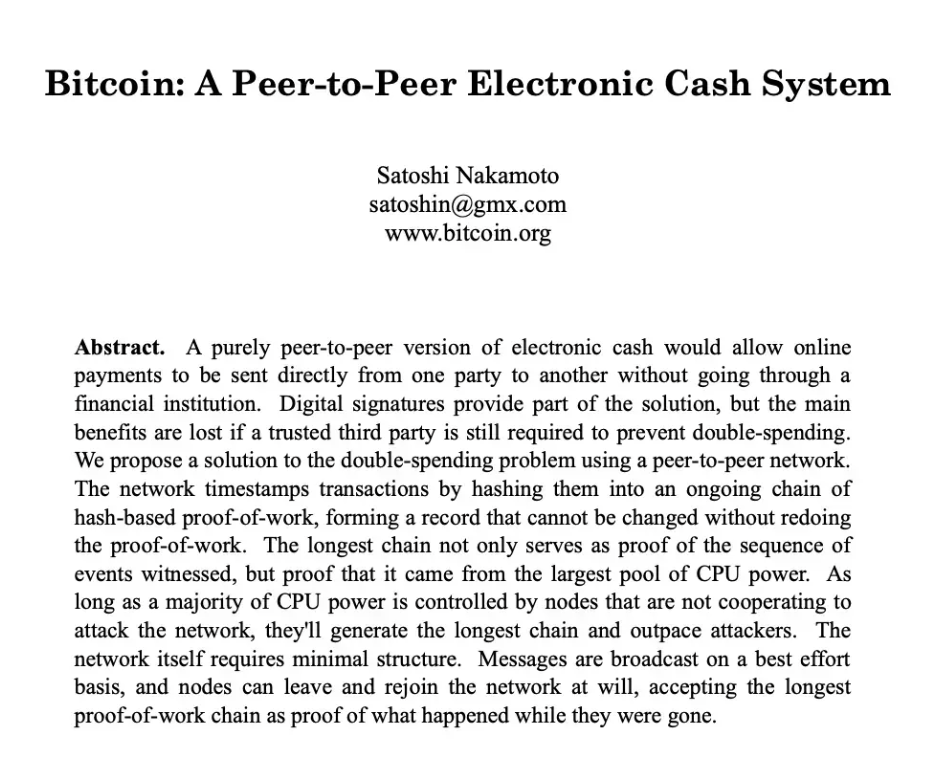
As the financial world crumbled during the Great Financial Crisis in 2008, an anonymous developer, Satoshi Nakamoto, published a design that combined earlier work on digital signatures, proof-of-work, and peer-to-peer networking into Bitcoin.