tech
Web 1.0: The read-mostly web
Explains how the read-mostly web of roughly 1990–2004 established open publishing protocols, in the first essay of a three-part web history series.
Parts of this essay were drafted with AI assistance.
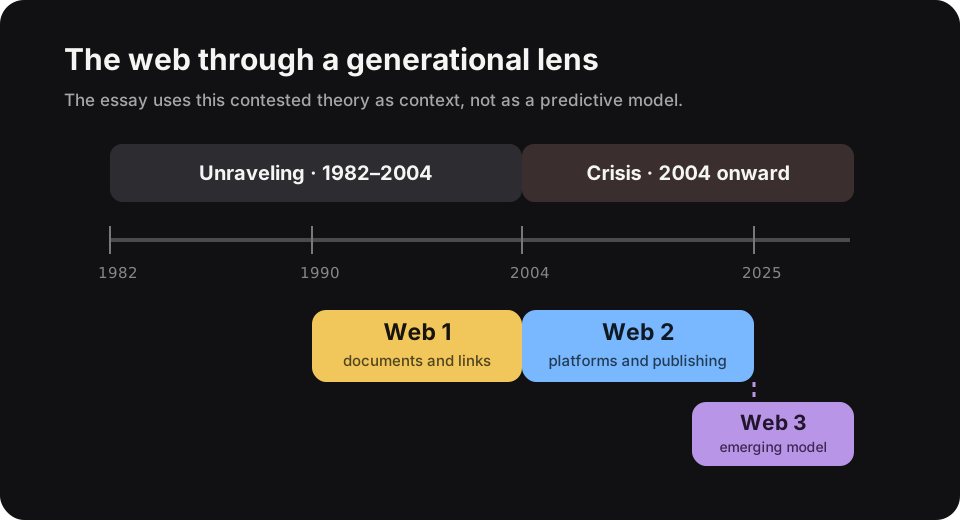
This essay begins a three-part history of Web 1, Web 2, and Web3 through the contested lens of the Strauss-Howe Generational Theory. Web 1 is shorthand for the read-mostly web of roughly 1990–2004.
The dates and labels in this series are editorial shorthand, not formal web standards. Technologies and behaviors overlap across each period.
The periods overlap; they are not clean technical boundaries.
Web eras at a glance
Below is a one-line description of each era.
Web 1 = Read-mostly websites and open publishing protocols. (1990–2004)
Web 2 = Interactive and user-generated platforms. (2004–present)
Web3 = Blockchain-based applications and assets. (roughly 2017–present)
Strauss-Howe generational theory
For a deeper understanding of the cultural shifts underlying the advancements and applications of the Internet, this series distills a cross-generational perspective through the lens of the Strauss-Howe Generational Theory.
The theory details a recurring cycle of generations that introduce archetypes with behavioral traits associated with the period in which they grew up.
The theory is a contested interpretive framework. Historians criticize it as unfalsifiable pattern-matching, and this series does not argue for its validity. It's used here only as an anthropological lens for viewing technological shifts.
Rather than detail each of the theory's components, the scope of this essay will only pertain to the four generational shifts that occur before repeating.
Below are descriptions of each generational period and their associated archetypes.
In the authors' model, each period lasts about 20–23 years and the cycle repeats every 80–92 years. Those intervals are part of the theory, not established laws.
The theory focuses mainly on Anglo-American history and should not be generalized to every culture.
The unraveling
The time period that Web 1 operated within, 1990–2004, coincided with the Unraveling as described in the Strauss-Howe theory. This era of the Unraveling, 1982–2004, is described by its authors as a period when individualism rises and trust in institutions falls.
The Unraveling / Web 1 presented a period when institutions were weak, individualism prospered, and society fragmented into many different factions.
This perspective is directly connected to the ethos of the early Internet, which was full of idealistic visions of a more democratic and free society.
Open protocols embodied some of this ethos, even as large companies became dominant distribution and access points.
This centralization of power to a handful of content distribution channels had lasting ramifications on Web 1 and formed the roots for Web 2's monolithic intermediaries to flourish.
Generational influences
The generation born into the era preceding the Unraveling, known as the Awakening, were Nomads.
Theoretically, they grew up with a sense of alienation and insecurity due to the tumultuous time period in which they were raised.
In the theory, Nomads are said to become practical and resilient adults. That is a cohort-level claim, not evidence about any individual.
Nomads were the prevailing leaders during this period of Unraveling, and they were met with resistance from the up-and-coming Millennial generation, which aligns with the Hero archetype.
Heroes grow up to be optimistic and overconfident adults, and some come to wield enormous power. The theory would place leaders such as Mark Zuckerberg, born in 1984, in this cohort, but it does not explain an individual's behavior.
These leaders, who "move fast and break things," eventually became the incumbents in the industries they disrupted during the Unraveling.
They then helped re-strengthen institutions through the business models implemented in the Crisis phase, which follows the Unraveling.
The series uses that claimed power transfer as a narrative device, not a prediction that one generation or technology will displace another.
This framework offers one interpretation of how institutions and individuals interacted during Web 1. It cannot establish that generational archetypes caused Web 2's business models.
The world became privy to new forms of communication, and suddenly, every company needed a website. This is analogous to the early days of Web 3 when every person and company involved suddenly needed a wallet.
What unraveled
The era directly after World War 2 was known as the High, defined by strong institutions and the homogeneity of ideas. Individuals were convening on how they wanted culture to move forward.
Still, by the time US President John Kennedy was assassinated in 1963, this collective idealism was discarded, and burgeoning cultural movements prompted the next era, the Awakening, to begin. These movements highlighted issues that those in charge during the High deemed insignificant, such as racial equality, sexual discrimination, and artistic expression.
This Awakening period brought these issues to the forefront of public consciousness and began tarnishing the image of sublimity that the US had managed to muster.
In the theory's account, individuals strengthened their convictions while loosening their identification with institutions.
Historical context
Individual wealth and global supply chains
The global stock market experienced historic booms during the mid to late 1980s, creating enormous wealth for specific individuals and prompting the modern age of consumerism.
This also aligned with the globalization of supply chains, which expanded cross-border trade and production. As companies took advantage of the benefits that outsourcing could bring to their bottom line, power began transmitting from domestic networks to a global supply chain layer with complex webs of intermediaries and agendas.
This created new opportunities while also concentrating power in multinational firms and exposing workers and countries to supply-chain shocks.
Distrust, adaptation, and obsolescence
Major companies in tobacco, energy, agriculture, and auto manufacturing faced public investigations and lawsuits over safety, health, and environmental claims. Meanwhile, cable news and early online publishing expanded the number of information channels. These changes contributed to a more fragmented media environment, though no single technology caused the political divisions that followed.
Blockchains, non-custodial wallets, and NFTs created new forms of digital ownership, but owning a token does not necessarily confer ownership or control of the network, company, intellectual property, or underlying asset.
Web 1 technical evolution
Web 1 history
Packet-switched computer networking predates the 1980s. The ARPANET transition to TCP/IP in 1983 is one practical milestone in the history of the Internet.
Major computing centers were being built worldwide but lacked adequate standardization, preventing network interoperability.
TCP/IP enabled previously separate networks to interoperate (the ARPANET switched over in 1983). Tim Berners-Lee proposed the World Wide Web in 1989 and demonstrated the first successful client-server communication over HTTP in late 1990.
Commercial internet service providers (ISPs) expanded public access during the early 1990s. The first web page went live on August 6, 1991.
The first website, and many more built during the 1990s, had severe limitations compared to today's websites. They typically contained text and hyperlinks, which brought you to another website with the same format. "Read-only" is the era's shorthand, though it was never literally true; email, Usenet, IRC, forums, and guestbooks all let people write back; what Web 1 lacked was the platformized, in-browser publishing that defined Web 2. As these websites evolved, the content distribution function of the Internet became more efficient. By the year 2000, per early industry trackers like Netcraft and the ITU, over 17 million websites existed and over 360 million people were browsing them. Many of these websites followed the same text-and-links pattern and rarely involved user interaction.
The Internet represented a collection of documents, although a few key innovations occurred in programming languages that helped lay the groundwork for Web 2.
Innovations
New languages, browser capabilities, authoring tools, and hosting services expanded what websites could do. They also created specialized roles such as interface designer, back-end developer, and application engineer. Lower costs and better tools reduced some barriers while increasing technical complexity.
HTML
Early HTML described text, headings, lists, and links. Image support arrived in popular browsers in 1993, and later standards added richer media and document semantics.
CSS
Before CSS (Cascading Style Sheets), proposed in 1994 and standardized as CSS1 in 1996, content and presentation were one and the same. With CSS, designers and developers could separate the two and concentrate on implementing the website's visual experience.
JS
Although CSS arrived in the mid-1990s, it didn't become mainstream until the early 2000s.
JavaScript, created at Netscape in 1995, spread even faster: Microsoft shipped its own compatible implementation (JScript) in Internet Explorer, and the language was standardized as ECMAScript in 1997.
Microsoft controlled over 90% of the browser market through Internet Explorer at its peak, so whatever ran in IE effectively ran everywhere, which cemented the language's dominance.
Over the years, many new languages have been implemented across the Internet, but HTML, CSS, and JS remain dominant.
Impact and legacy
Setting the stage
Although Web 1 was built during an Unraveling phase, which implies weak institutions and a strong sense of individualism, it ironically set the stage for institutions to wield more power than ever before.
Research institutions, standards bodies, companies, and independent developers all contributed. CERN supported the web's invention; the IETF and W3C developed open standards; browser and software vendors shaped implementation.
The physical and digital infrastructure and the standards and protocols enacted by these intermediaries created markets that companies such as Google and Facebook later came to dominate.
Lower production and distribution costs
Digital technology can lower the marginal cost of producing and distributing some goods, though it can also create new costs and concentrated markets. Web 1 had high barriers to entry, which became shorter as the technology involved became more user-friendly. Individuals slowly gained more power as time passed, leading to rapid development and user interactivity through e-commerce websites, messaging services, and social media networks. This newfound power of the individual in unison with destabilized institutions mirrors the features of the Unraveling periods.
Open protocols outlasted Web 1
Web 1 established open protocols and publishing conventions that enabled mass adoption of the web.
Decentralized access to information and global interconnection persisted as design goals even as Web 2 concentrated users and data in large platforms.