crypto
Can cryptocurrency serve people without reliable banking?
Tests whether cryptocurrency can serve people without reliable banking, weighing self-custody against on-ramp dependence, liquidity risk, and user safety.
Most people worldwide have at least one bank account, but over a billion adults don't.
People without an account may have to store value physically, pay in cash, or use fee-charging alternatives. The consequences depend on which mobile-money, postal, cooperative, or informal services are available locally.
As blockchain technology has developed, users can generate a non-custodial wallet, which can hold keys for blockchain accounts without a bank custodian.
This removes a custodian from key storage and transaction authorization.
That can reduce account-closure and insolvency risk, but token issuers, interfaces, networks, law, and compromised keys can still restrict or remove access.
Funding the wallet and converting assets back into local currency still often requires an exchange, payment provider, mobile-money service, or bank.
Who is unbanked or underbanked
The unbanked have no account at a bank or mobile-money provider. The underbanked have an account but still rely on services such as money orders, check cashing, or payday loans. The World Bank's Global Findex counted 1.7 billion unbanked adults worldwide in 2017. Its 2021 update, published before this essay, lowered the estimate to roughly 1.4 billion.
Account ownership varies widely by country. Common barriers include cost, distance, documentation, lack of trust, and insufficient income, according to the World Bank's Global Findex surveys.
Financially stable countries are generally more banked; however, in the US, the "richest" country globally, the Federal Reserve's 2019 wellbeing report classified 22% of adults, roughly 63 million people, as unbanked or underbanked.
People without bank or mobile-money accounts often face higher barriers to earning interest, investing, paying bills online, shopping online, and accessing formal credit. Available alternatives vary by country. There is also the need to use alternative financial services like money orders and prepaid cards, which are inefficient and rack up fees.
While banking isn't a perfect system, reliable access generally expands the services and protections available to an individual.
The problem is that not all banks are good ones.
Banking access is not banking quality
The quality and protections of an account vary by institution and country. In the US, most bank accounts are FDIC-insured for up to $250,000: deposit $250,000 into an FDIC-insured account and eligible deposits are backed by the full faith and credit of the US government.
Deposit insurance, institutional quality, inflation, and currency risk differ substantially outside the United States.
This, along with internal political and external geopolitical pressures, can result in what's known as a bank run, where everybody tries to withdraw their money at or around the same time.
Banks fund assets with deposits, equity, and wholesale borrowing while keeping liquid resources for expected withdrawals. They do not hold every deposit as cash.
How bank lending creates deposits
Commercial banks generally create a deposit when they make a loan. Their ability to lend is constrained by capital, liquidity, funding costs, credit demand, underwriting, and regulation, not by mechanically relending a fixed fraction of one customer's deposit. The US reserve requirement has been zero since March 2020.
The balance-sheet mismatch still matters. Depositors can demand funds on short notice, while many bank assets mature later or cannot be sold quickly without a loss.
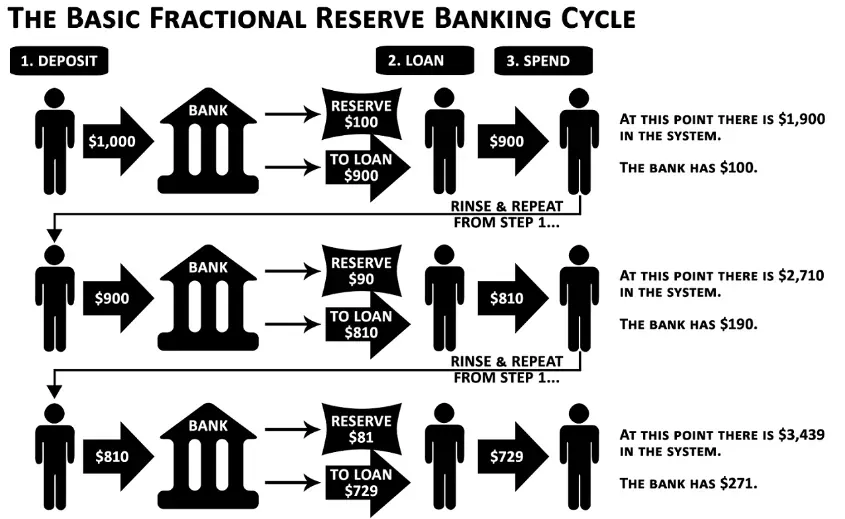
Bank credit can fund productive activity, consumption, or speculation. Its economic effect depends on underwriting, regulation, and where the credit flows.
Liquidity and systemic risk
Bank lending supports payments, investment, and consumption, but liquidity problems emerge when withdrawals exceed the cash and saleable assets a bank can obtain in time.
Depositors receive the account terms and interest rate they accepted; bank owners receive residual profits and losses. The systemic risk comes from the mismatch between liquid deposit claims and longer-duration or riskier assets, not from one borrower taking a specific depositor's cash.
Enforcement history
Financial institutions were central to the 2008 crisis, alongside failures in household lending, securitization, ratings, regulation, and risk management. They have also accumulated large enforcement penalties.
The Good Jobs First Violation Tracker records enforcement cases and penalties by parent company. Its late-2022 results placed several large banks among the companies with the highest cumulative penalties. The database is useful evidence of repeated misconduct, but its totals change as cases are added and do not measure the quality of every bank account.
What going bankless can and cannot mean
Self-custody creates an additional account model. It does not reproduce deposit insurance, consumer credit, chargebacks, or every service a bank provides.
Bitcoin, Ethereum, and other networks enabled users to hold keys and access on-chain applications without opening a conventional bank account. Users still trust wallet software, protocol rules, infrastructure, asset issuers, and any off-chain counterparty.
Non-custodial wallets manage keys for blockchain accounts. The blockchain records account state; the wallet is an interface and signer.
When you deposit money into any custodial account like a bank or centralized exchange, you trust this counterparty to honor your balance and access your funds.
The network verifies account state, while valid signing authority controls transactions. That authority may come from a private key, hardware signer, multisignature policy, or smart-account recovery design, not only a mnemonic phrase.
For more details, see Solflare's guide on mnemonic phrases.
The honest trade
Going bankless replaces banking risks with a different set of risks:
- volatile assets, including stablecoins with issuer risk
- network fees that can spike
- scams and phishing that often target newcomers
- personal responsibility for custody
- limited internet and smartphone access in places with low banking access
- uncertain regulation
- difficulty converting crypto into local currency
Whether the trade is worthwhile depends on the reliability of the available banking services.
What would count as progress
Digital bearer assets make self-custody easier to transmit across distance than physical cash or commodities, but adoption surveys do not show that users have replaced banking or improved their financial outcomes.
How far it goes will depend on the barriers above falling, including cheaper fees, better off-ramps, and safer wallets, not on the promise alone.