crypto
Building Crypto-Repos from open-source data
Explains how Crypto-Repos, a now-offline directory, turned Aptos, Sui, and Base repository data into searchable metrics, and where that data falls short.
Crypto-repos.com is no longer online. The counts and features below describe its April 2025 launch.
Crypto-Repos was an open-source directory of blockchain-related code built to make repositories and contributors easier to find.
The intended users were developers, project teams, recruiters, analysts, and blockchain foundations.
As of the April 2025 snapshot, it indexed 10,523 repositories and 7,457 contributors across Aptos, Sui, and Base. Those totals have two known limitations, detailed under Next steps. Forked repositories could double-count contributions, and some repositories were missing contributor information. Treat both numbers as upper bounds, not exact censuses.
The planned expansion was to cover more ecosystems represented in Electric Capital's annual blockchain developer activity report.
Problem, method, and intended result
Problem: blockchain development activity is scattered across thousands of repositories, and the standard aggregate view (Electric Capital's annual report) tells you how much activity an ecosystem has without letting you find which code and which people are behind it.
Method: index every repository in an ecosystem's crypto-ecosystems taxonomy file, pull per-repository and per-contributor metrics from GitHub, and make the result searchable and filterable.
Intended result: developers could find projects to use or contribute to; teams could inspect contribution history; and analysts could query a cleaned version of the source taxonomy. The launch did not establish that these uses improved hiring, contribution quality, or ecosystem outcomes.
Launch interface
Repository metrics and contribution history
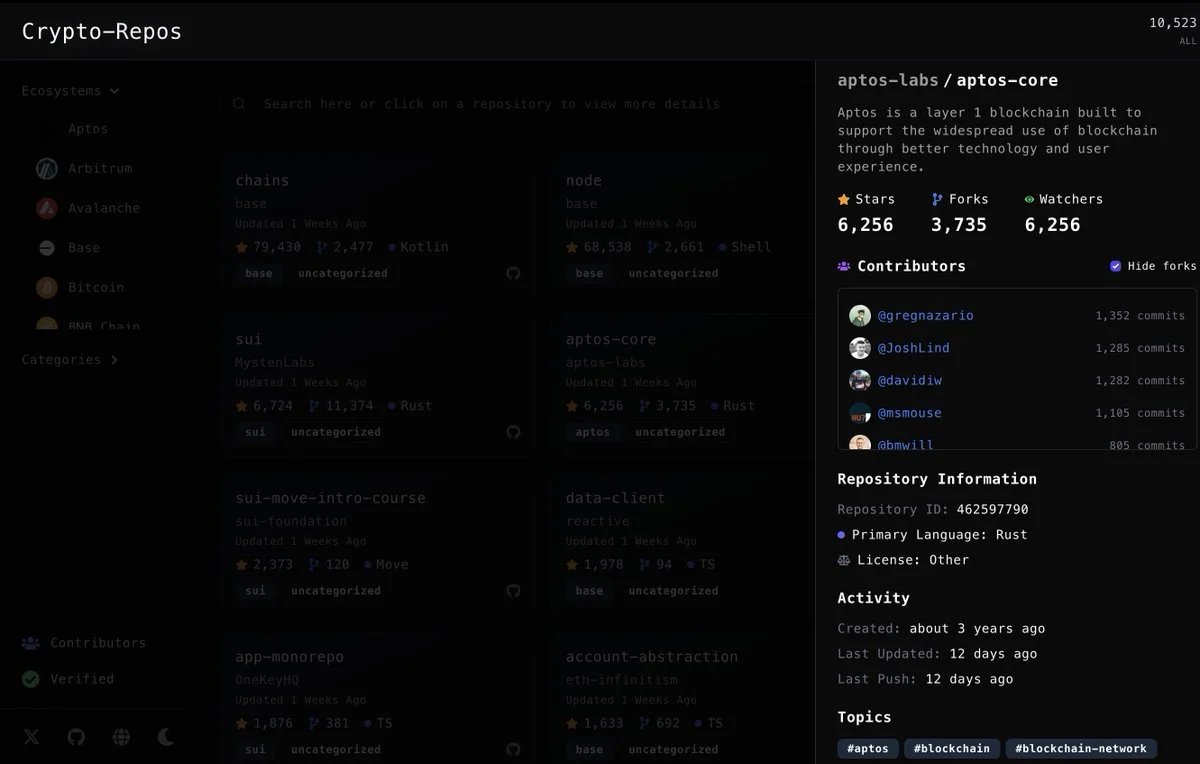
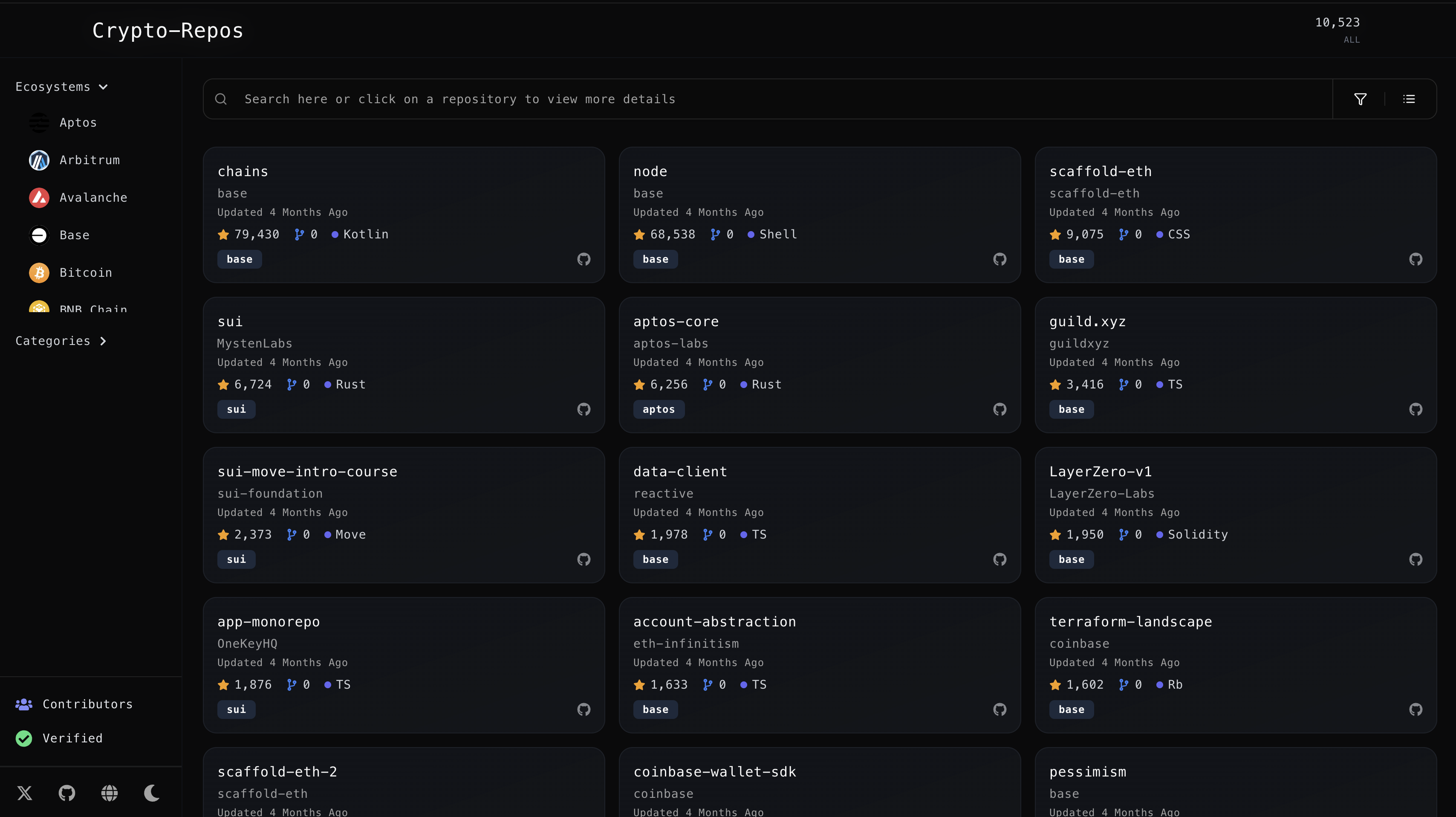
Search across ecosystems and categories
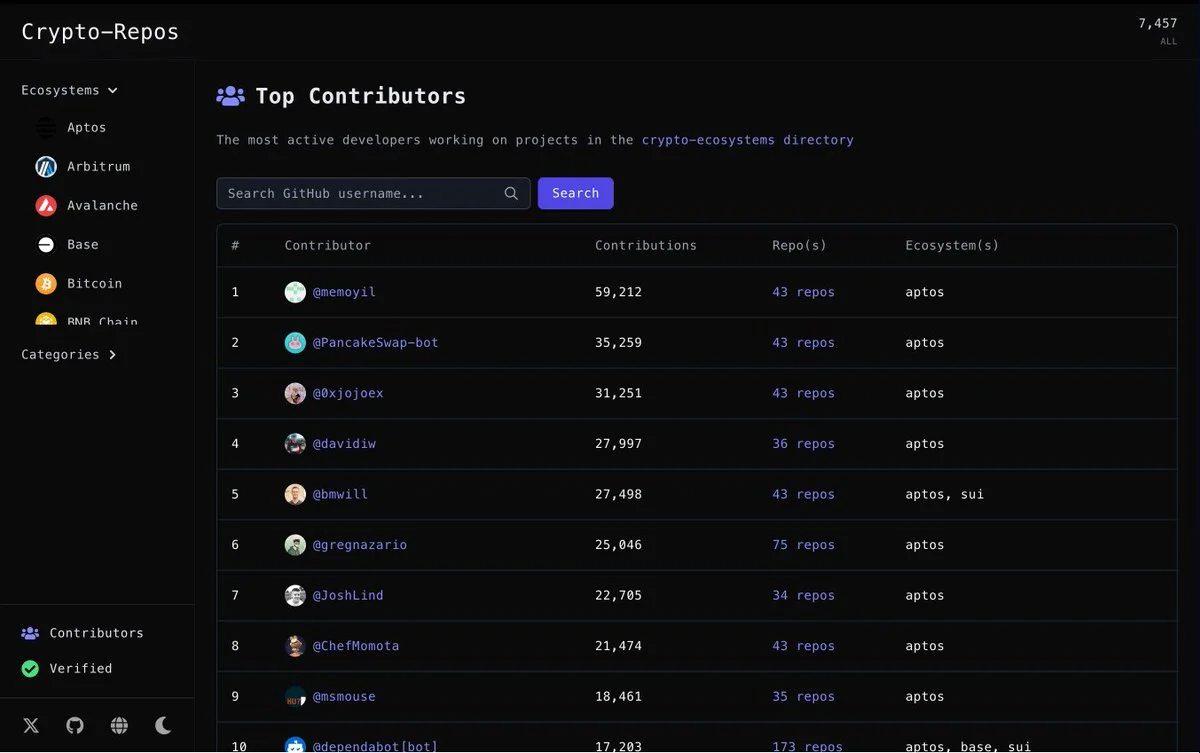
Contributor activity across repositories
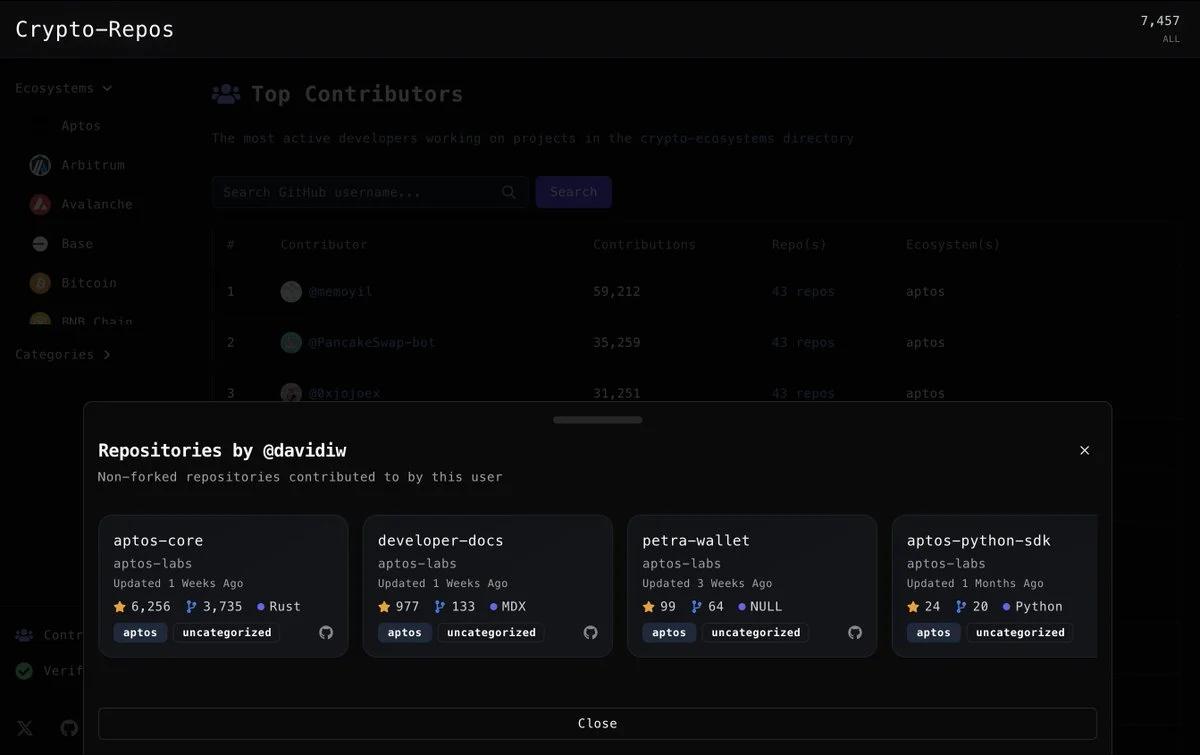
Individual contribution history
Limits of repository data
Measuring the success of permissionless blockchain ecosystems is not easy.
Metrics like transaction volume, user counts, and on-chain activity can be distorted by incentives, bots, sybil accounts, and related-party behavior.
Incentives can attract automated or coordinated activity that makes genuine and simulated engagement hard to distinguish. Pseudonymous addresses compound the measurement problem because an address does not equal one person.
Developer activity provides another view, but it does not replace product usage, security, financial, or governance measures.
Repository history can show who contributed, how often code changed, and which projects are connected. It cannot by itself establish code quality, independent developers, or genuine ecosystem growth.
What open source does and does not show
Open source makes code inspectable and reusable under its license. It does not prove that deployed bytecode matches the repository, that anyone audited the code, or that the project is trustworthy. Use as training data also depends on license terms and the downstream use.
DeFi can benefit when published source, verified deployments, audits, and active review make behavior easier to inspect. None of those conditions is guaranteed by a public repository alone.
Estimating the ratio of closed to open source code in crypto would require data from infrastructure providers and cross-referencing with reports on open-source blockchain code like Electric Capital's developer activity report.
No defensible multiplier was available for estimating private repositories, so the indexed totals covered only the observable open-source taxonomy.
Electric Capital's annual report
Electric Capital's annual developer report provides one method for comparing aggregate developer activity across ecosystems.
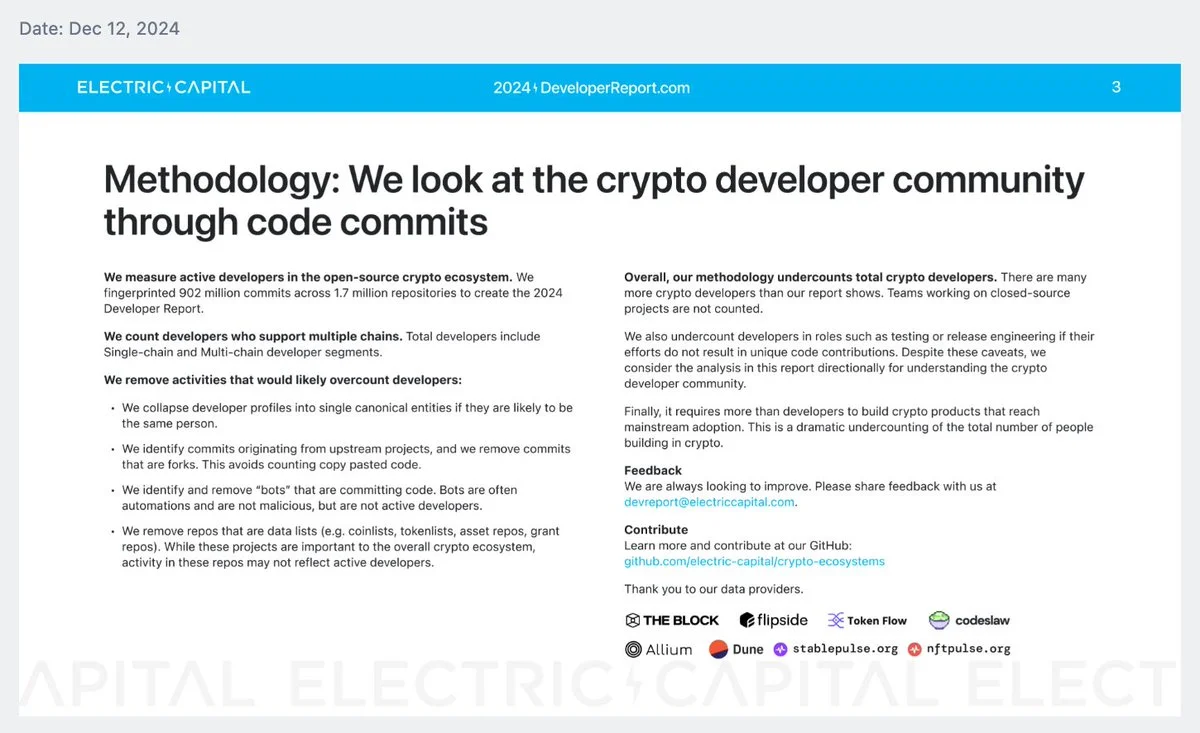
The crypto-ecosystems repository is a taxonomy hosted on GitHub that categorizes and tracks open-source blockchain development across various ecosystems.
Maintained by Electric Capital, this collaborative database allows anyone to contribute by adding links to blockchain-related code repositories under specific ecosystems.
At launch, ecosystem .toml files listed repositories associated with each
blockchain taxonomy. Inclusion did not establish that code was deployed on that
chain.
Quantity does not establish quality
The report analyzes the number of commits, full-time developers, monthly active developers, and more.
Electric Capital maintains its definitions of a full-time or monthly active developer, its own quality assurance standards, and the right to alter the calculation methodology, so some metrics may change over time.
GitHub activity can be manipulated. Methodological filters may reduce that problem but cannot remove it.
Repository metrics don't always capture development quality; a high commit count might reflect minor updates rather than substantial development.
Other factors complicate quality assessment:
- Code Accessibility: Many projects maintain hybrid repositories where core functionality remains private while only specific components are public
- Repository Maintenance: A repository might show recent commits but be in maintenance mode
- Code Reuse and Forking: The prevalence of forked repositories and templated code can inflate repository counts
- Documentation Quality: The presence and quality of documentation significantly impacts project usability
The taxonomy supports repository and contributor counts, but assessing impact requires inspecting the code, maintenance, adoption, and contributor history.
Crypto-Repos exposed more granular repository and contributor records. Those records supported inspection, not a definitive score of quality or impact.
Platform at launch
- Full index of the Aptos, Sui, and Base ecosystem files from
Electric Capital's
crypto-ecosystems
taxonomy, totaling 10,523 repositories
and 7,457 contributors (the per-ecosystem
.tomllayout linked in the original has since been restructured upstream) - Searchable repository page with advanced filtering by ecosystem, language, stars, and keywords
- Searchable contributor page featuring ranked profiles, contribution metrics, and repository histories
Implementation at launch
- Front end: Next.js, Tailwind CSS
- Back end: Neon, Hasura
- Data collection: Electric Capital, GitHub
- Deployment: Vercel
Next steps planned in April 2025
- Resolve known errors: Some repositories don't show all contributor information, and some contributor details include forked repositories, duplicating their contribution counts
- Data updates: Implement weekly update schedule for
.tomldata - Data expansion: Add support for more than 200 additional blockchain ecosystems using GitHub's API and the crypto-ecosystems dataset
- Search enhancement: Optimize search using Hasura and vector embeddings.
Other planned work:
- Categorization v1: Build a filter system to sort categories for repositories
- Visualization: Build proper developer profiles with detailed programming language usage statistics
- Verified pages: Build blockchain-specific pages featuring verified open-source projects, their source code, and their top contributors
Future plans, archived
Community building
- Highlighting active projects and contributors (Repo/Contributor of the Day)
- Creating visibility for emerging technologies
- Creating insightful reports on ecosystem trends
- Supporting community-driven categorization of projects to define new and incumbent crypto verticals
Developer talent platform
- Reputation-based skill verification
- Ecosystem-specific bounty boards
- Team building tools
The site launched at crypto-repos.com; as noted above, it is offline as of 2026.