finance
Decentralized finance: Open access and remaining risks
Makes an October 2022 case for open protocol access in DeFi, separated from the custody, market, and regulatory risks and control points that remain.
The global financial system is built on a dense web of intermediaries that handle trillions of dollars in daily transactions.
This essay preserves a case for DeFi made in October 2022. Later edits add sources and account for failures already visible that year. It is an argument, not financial advice or a claim that DeFi is safe for every user.
This architecture supports trade and capital movement, but it also concentrates operational, liquidity, and compliance risk. Violation Tracker records repeated enforcement actions against large financial institutions. Its cumulative totals change as cases are added, and they do not by themselves measure account quality or systemic risk.
The lines between regulator and regulated can also be blurry.
Gary Gensler, SEC chairman at the time of this writing, spent 18 years at Goldman Sachs, becoming one of the youngest partners in firm history, before overseeing Wall Street.
Fed Chair Jerome Powell was a partner at The Carlyle Group from 1997-2005, building wealth in private equity and investment banking before setting monetary policy.
Janet Yellen earned over $7 million in speaking fees in 2019-2020 from Wall Street firms including Citi, Goldman Sachs, and Credit Suisse before becoming Treasury Secretary, a role that shapes financial policy and participates in interagency oversight.
To be precise about what this shows: none of these career paths is evidence of wrongdoing, and deep industry expertise is arguably a prerequisite for the jobs. The documented facts are about proximity, not corruption. The so-called "revolving door" between Wall Street and Washington is a recurring policy concern because it can create actual or perceived conflicts that require disclosure and oversight.
Central banking mandates and mechanics
The Federal Reserve was formed in 1913 after a series of bank runs.
An early plan was developed at a private November 1910 meeting on Jekyll Island, where six participants discussed a framework that influenced the eventual Federal Reserve Act.
The Federal Reserve System combines a federal Board of Governors with 12 regional Reserve Banks. Congress sets its statutory goals, while monetary-policy decisions are insulated from day-to-day executive approval.
Its "dual mandate" was formalized in 1977 through the Federal Reserve Reform Act:
- Maximize employment
- Maintain price stability (interpreted as roughly 2% inflation since 2012)
While monetary policy has evolved, its tools have remained consistent: interest rate adjustments, balance sheet expansion, and open market operations.
Since January 2012, the Fed has explicitly targeted 2% annual inflation, and this goal has widespread implications for asset values and the purchasing power of the U.S. dollar.
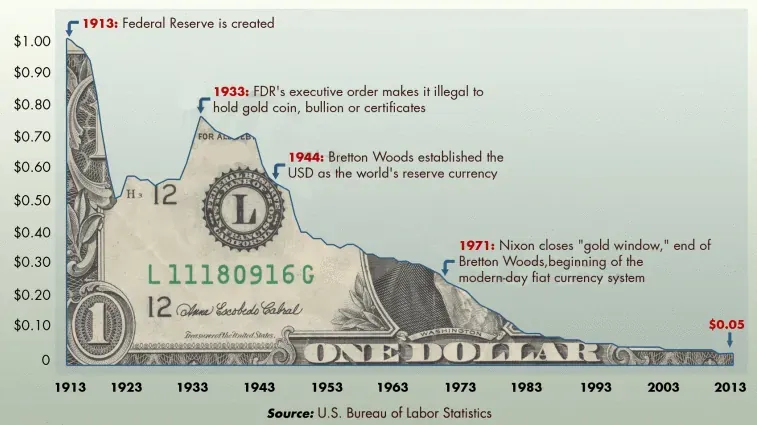
Interest rates fell across much of the period from the early 1980s through 2020, then rose sharply in 2022. Changes in inflation, growth, demographics, saving, policy, and risk all affect borrowing costs, so financial sophistication alone does not explain the trend.
Value and perception
Since 2008, the Fed's balance sheet and the S&P 500 often rose during the same periods. That co-movement does not establish that one caused the other; both responded to financial conditions and economic shocks.
The U.S. dollar's reserve currency status arguably provides more flexibility for monetary expansion than other nations possess, with global demand for dollars potentially buffering against inflationary pressures, but not every country enjoys that privilege.
In countries with unstable currencies or restrictive capital controls, some people have used dollar-linked stablecoins and crypto payment rails as an alternative. That does not make DeFi necessary or accessible to everyone.
Traditional banking does not solve every problem. Currency devaluation, capital controls, limited infrastructure, and political instability can restrict which financial services people can use.
Stablecoins and inflation hedges
Between 2021 and 2022, Turkey experienced severe economic turmoil with inflation reaching 78.62% year-over-year in June 2022 according to the Turkish Statistical Institute (TURKSTAT), the highest rate in 24 years.
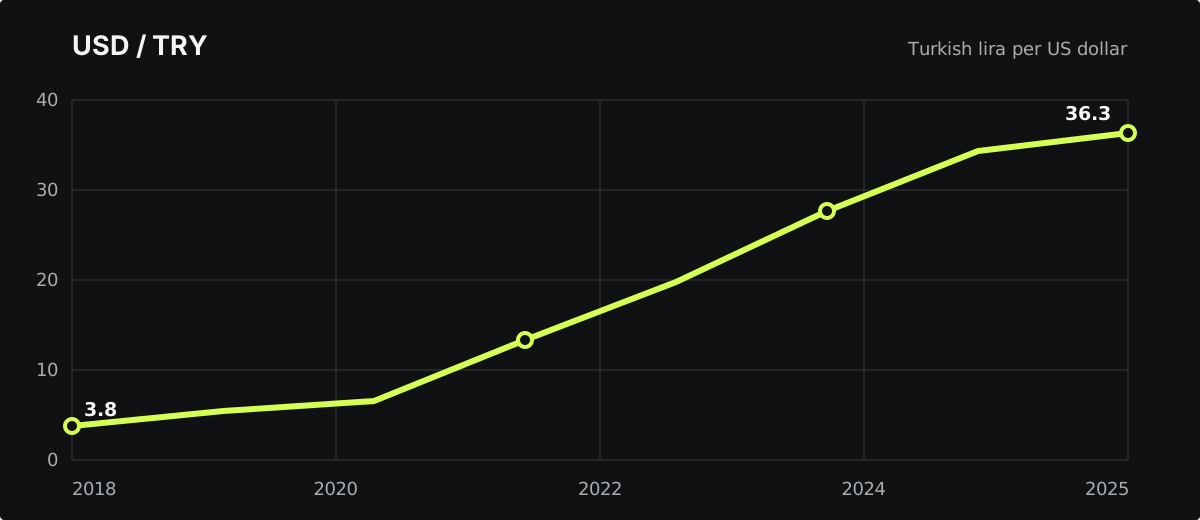
Holding a dollar-linked stablecoin could reduce exposure to the lira, but it introduced issuer, reserve, custody, smart-contract, exchange-rate, and legal risk. Access also depended on internet service, a compatible exchange or peer, and the user's ability to secure keys.
Self-custodied wallets did not require a bank account, but obtaining or cashing out stablecoins could still require identity checks. A private key controls an on-chain account; many wallets derive keys from a recovery phrase.
Censorship resistance
In early 2022, Chinese authorities froze approximately $1.5 billion in customer deposits across four rural banks in Henan province.
When protestors gathered in July 2022, officials reportedly manipulated COVID health tracking systems, according to the U.S. State Department's 2022 human rights report to restrict travel and limit dissent. Over 1,000 depositors protested, and hundreds of thousands were locked out of their funds.
Chinese authorities later arrested 234 suspects allegedly involved in the banking scandal.
The episode shows how centralized institutions can restrict access to funds. Open protocols can reduce dependence on one local bank, but interfaces, stablecoin issuers, validators, governance bodies, and internet providers remain possible control points.
Yield and innovation
DeFi protocols have introduced programmable implementations of financial primitives such as lending, borrowing, trading, insurance, and more, though this innovation introduces new technical and economic risks.
The risks were substantial in 2022. Terra's algorithmic stablecoin erased tens of billions of dollars in May. The Ronin and Wormhole bridge hacks took nine-figure sums. Governance power often remained concentrated among a few large token holders, and centralized stablecoin issuers retained the power to freeze funds. The US sanctioning of Tornado Cash in August showed that enforcement reaches protocol-level infrastructure. Survivorship is doing real work in any optimistic DeFi narrative, this one included.
Automated market makers and liquidity pools show one durable design: public smart contracts can quote trades and distribute fees to liquidity providers. The contracts may be inspectable, but users still face code, oracle, governance, liquidity, and adverse-selection risk.
This differs from traditional venues where market-making access is usually permissioned, though regulated markets also publish rules, quotes, and trade data.
Centralized and decentralized systems will coexist
Financial systems are likely to combine centralized institutions with public and private programmable ledgers.
DeFi is not a wholesale replacement for traditional finance. It offers open access to some settlement and market functions, subject to technical, infrastructure, asset, and legal constraints.
In economies hampered by inflation or financial repression, crypto rails can solve some practical problems while creating others.
In countries with reliable insured accounts, the incremental value of those properties may be smaller.
For most people in stable economies, traditional banking offers superior convenience, consumer protections, and reliability that DeFi hasn't fully matched yet. Tokenized settlement may narrow the gap, but adoption depends on regulation, privacy, interoperability, and whether it improves costs or reliability.
The market includes users seeking self-custody, teams building financial software, professional capital, and substantial speculative activity. Higher advertised yield does not imply higher risk-adjusted return.
DeFi expands access but retains control points
Decentralized systems offer a test bed for open settlement, programmable assets, and self-custody. Their strongest property is not guaranteed freedom or yield. It is the ability to inspect and interact with shared financial software without asking one platform to maintain the ledger. Whether that is better than a regulated intermediary depends on the user, jurisdiction, asset, and failure mode.